
By Spin Number · April 2026 · 9 minute read
The best coin flip is one of the oldest decision-making tools in existence. Two outcomes, equal probability, instant result. No deliberation, no bias, no argument. A virtual best coin flip brings this same simplicity into a digital environment, and understanding exactly how it works makes it significantly more useful than it first appears.
This guide covers the mechanics behind a virtual coin flip, what the adjustable settings actually do, the psychology that makes coin flips work even when people think they do not need them, and the specific situations where a coin flip is the right tool versus the situations where it is not.
Table of Contents
How a Virtual Best Coin Flip Works
When you click to flip, a pseudo-random number generator (PRNG) produces a value that determines the outcome before the animation begins. The coin spins and lands on that pre-determined result. The animation is a visual representation of a decision that has already been made, not a process that is still unfolding.
Each flip is statistically independent. The outcome of one flip has no mathematical relationship to the next. A sequence of ten heads in a row does not change the probability of the eleventh flip. It remains exactly 50 percent heads and 50 percent tails, as it was for every previous flip.
This independence explains a common and persistent misconception known as the gambler’s fallacy: the belief that after a streak of heads, tails becomes more likely because the distribution needs to “balance out.” In reality, a coin has no memory. Each flip begins with equal probability regardless of everything that came before it.
Over a large number of flips, results tend to converge toward a balanced distribution. This is the Law of Large Numbers in practice. But short sequences can appear highly uneven, and that unevenness is a natural property of randomness, not a flaw in the tool.
From a strictly statistical standpoint, a virtual coin flip is often fairer than a physical one. Real coins carry subtle structural imperfections, weight imbalances from the stamping process, and are vulnerable to the physics of the human toss, which can slightly favor the side facing up before the flip. A PRNG-based virtual flip removes all of these physical variables, delivering two outcomes with equal probability on every use.

What the Different Settings Actually Do
Digital best coin flip tools typically include adjustable settings. These do not affect the randomness of individual outcomes, but they change how the experience is presented and how useful it is in different contexts.
Number of flips. This determines how many results are generated at once. A single flip is ideal for simple binary decisions. Multiple flips at once are useful for demonstrating probability patterns in educational settings, creating sequences for games, or generating several outcomes without repeating individual actions. Generating ten flips at once does not make any individual flip more or less fair. Each result is statistically independent regardless of how many are generated together.
Flip speed. Slower speeds build anticipation in group settings where the visual experience matters. Faster speeds deliver results immediately when efficiency is the priority. The speed has no effect on the randomness or the probability of the outcome.
Reset. The reset function clears displayed history, counters, and result percentages from the current session. It has no effect on future outcomes. Because the PRNG generates each flip independently using a fresh seed, clearing the history changes nothing about what comes next. Reset is a display tool, not a randomness tool.
The Psychology of the Best Coin Flip
A best coin flip can reveal preferences that were not consciously acknowledged before the flip happened. This is one of its most underappreciated uses.
When you assign one option to heads and another to tails, the result often produces an immediate emotional response: either relief or a quiet sense of disappointment. That reaction is information. It indicates which outcome you actually wanted, independent of whatever reasoning you applied to the decision beforehand.
Research in behavioral psychology, including work by Damasio (1994) on somatic markers in decision-making, suggests that immediate emotional responses to outcomes are often more reliable than extended deliberation when evaluating simple binary choices. The reasoning brain can construct arguments for either option. The emotional response often reflects a genuine preference that the reasoning process was obscuring.
In this sense, the coin flip acts less as a decision-maker and more as a decision clarifier. The flip itself is not what resolves the question. Your reaction to the result is.
A practical application: if you flip and feel the immediate urge to flip again because you did not like the result, that urge is the answer. You preferred the other option. The coin did its job by revealing that, even if you plan to override the result.
When a Best Coin Flip Is the Right Tool
Binary decisions between genuinely equal options
The best coin flip is most effective when two options are genuinely equivalent and additional analysis would not produce a better outcome. When both options have similar costs, similar benefits, and similar risks, the time spent deliberating has diminishing returns. A coin flip produces an immediate result and allows you to move forward.
The key qualifier is genuinely equal. If one option is objectively better on measurable criteria, the coin flip is not the right tool. If both options are defensible and the choice between them is a matter of preference rather than analysis, the coin flip resolves the decision at zero cognitive cost.
Settling disputes fairly
A coin flip provides a neutral, widely accepted method for resolving disagreements between two parties. Its effectiveness depends entirely on both parties agreeing to accept the result before the flip happens, not after. A coin flip that one party can challenge after seeing the result is not a coin flip. It is a negotiation with extra steps.
For higher-stakes disputes where the outcome matters significantly to both parties, a visible digital flip on a shared screen removes any possibility of questioning whether the flip was fair. Both parties see the same result at the same moment.
Probability demonstrations in educational settings
Multiple flips can illustrate how probability works in practice, particularly in mathematics and statistics contexts where visual examples help understanding. A class watching ten flips produce seven heads and three tails, and then watching a hundred flips converge toward fifty-fifty, experiences the Law of Large Numbers as an observable phenomenon rather than an abstract formula.
For teachers looking for ways to integrate probability demonstrations into lessons without preparation, our article on no-prep classroom resources that actually work includes probability activities alongside other instant engagement tools.
Game mechanics and turn order
Coin flips are the standard method for determining starting positions, turn order, or first-move advantage in games where fairness is required and both parties need to accept the result. The virtual version works identically to a physical flip in this context, with the added benefit of a visible, shareable result.
When a Best Coin Flip Is Not the Right Tool
Understanding when not to use a coin flip is as important as knowing when to use one.
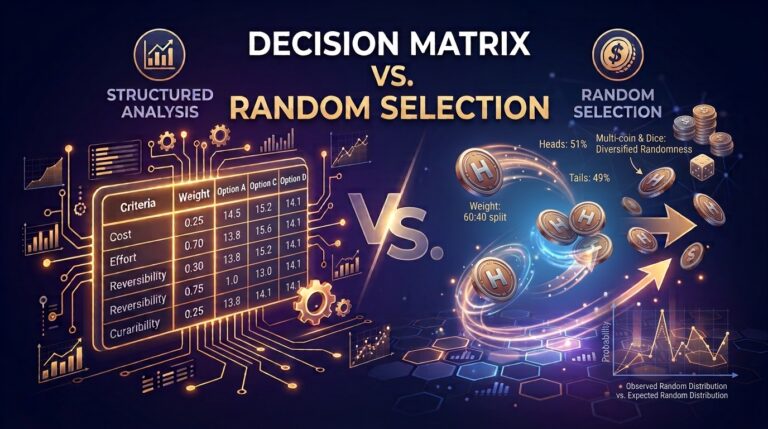
When the options are not equal. If one option is objectively better on any measurable criterion that matters, choosing between them randomly discards the information you have. Structured analysis is more appropriate when the options differ in meaningful ways.
When the consequences are significant and irreversible. Decisions involving financial commitments, health outcomes, career changes, or long-term relationships require deliberate analysis. The coin flip is suited to low-stakes binary choices where both outcomes are manageable. When one outcome would be genuinely difficult to recover from, randomness is not an appropriate decision mechanism.
When the result will not be accepted. A coin flip that gets repeated until a preferred outcome appears is not a coin flip. It is a way of reaching a predetermined decision while maintaining the appearance of randomness. If there is a chance either party will not accept the result, address that condition before flipping, not after.
When more than two options exist. A coin flip resolves binary decisions. For decisions with three or more options, a random number generator, a spinner wheel, or a structured elimination process is more appropriate. Forcing a multi-option decision into a coin flip sequence produces results that feel arbitrary rather than fair.
For a direct comparison of coin flips with other randomization tools and when each is the right choice, our article on coin flip vs yes or no wheel: how to choose the right decision tool covers the practical differences in detail.
Using Multiple Flips Effectively

Generating multiple results at once is useful in three specific contexts.
Probability demonstrations. A sequence of 20 or 50 flips generated at once shows the distribution pattern more clearly than single flips repeated manually. Students watching the cumulative distribution shift toward fifty-fifty as the sample size increases understand the concept in a way that a single flip cannot demonstrate.
Game sequences. Some games require a predetermined sequence of random outcomes rather than individual flips at decision points. Generating the full sequence in advance removes interruptions and keeps the game moving.
Repeated decisions with the same structure. If the same binary decision recurs across a session, such as randomly assigning which of two options applies to each item in a list, generating multiple flips at once is faster than individual flips and produces the same statistical quality.
Coin Flip vs. Other Randomization Tools
| Tool | Best for | Number of outcomes | Visible process |
|---|---|---|---|
| Virtual coin flip | Binary decisions, disputes, turn order | 2 | Yes |
| Random number generator | Numbered selections, ranges, draws | Any range | Yes |
| Spinner wheel | Named options, group selections | 2 to many | Yes |
| Dice generator | Games, probability with multiple outcomes | 2 to 20 | Yes |
For decisions with more than two options, a spinner wheel or random number generator is more appropriate than a coin flip. The random number generator handles any range and produces results with the same statistical independence as a virtual coin flip.
Frequently Asked Questions
Is a virtual coin flip as fair as a physical coin?
Yes, and statistically it is often fairer. Physical coins have subtle manufacturing imperfections and are vulnerable to the physics of the human toss, which can introduce a slight bias toward the side facing up before the flip. A PRNG-based virtual flip removes all physical variables and delivers exactly 50 percent probability for each outcome on every flip.
Does flipping more times improve the fairness of individual flips?
No. Each flip is statistically independent with exactly 50 percent probability regardless of how many flips precede it. Flipping more times does not change the fairness of any individual flip. It does, however, demonstrate the Law of Large Numbers: over a large sample, the cumulative distribution converges toward fifty-fifty even when short sequences appear uneven.
Should I follow the result or my reaction to it?
Both are useful, but for different purposes. If you are using the flip as an impartial tiebreaker between two parties, follow the result to maintain trust in the process. If you are using it alone to resolve personal hesitation, your immediate reaction to the result is often more informative than the result itself. A strong feeling of disappointment or an urge to flip again indicates a preference you had not consciously acknowledged.
Can I use a virtual coin flip on mobile?
Yes. A well-built virtual coin flip tool works on any modern mobile browser without requiring a download or installation. The interface should scale correctly to any screen size, and the flip function should be fully accessible via touch. Test the tool on your specific device before using it in a group setting to confirm the display works as expected.
What does the reset function do?
Reset clears the displayed history, counters, and cumulative result percentages from the current session. It has no effect on future outcomes. Because each flip is generated independently with a fresh seed, the reset changes only what is displayed, not the randomness of what comes next.
Is a virtual coin flip free to use?
Most web-based virtual coin flip tools are free to access with no account required. The tool at Spinumbers is free, requires no registration, and works directly in any browser on any device.
Conclusion
The best coin flip remains one of the simplest and most reliable tools for resolving binary decisions. Its value comes from three properties that no amount of deliberation can replicate: equal probability, immediate results, and complete absence of bias.
In digital form, a virtual best coin flip becomes more practical and more verifiable than its physical counterpart. The result is generated before the animation, the probability is exact rather than approximate, and the outcome can be shared on a screen so every participant sees the same result at the same moment.
Used appropriately, a coin flip is not just a randomizer. It is a way to move forward when additional thinking no longer adds value, to resolve disputes without argument, and to reveal preferences that deliberation was obscuring. Knowing when those conditions apply is what makes the difference between a coin flip that resolves a situation and one that only delays it.
References
Damasio, A. R. (1994). Descartes’ error: Emotion, reason, and the human brain. Putnam.
Kahneman, D. (2011). Thinking, fast and slow. Farrar, Straus and Giroux.
Nickerson, R. S. (2002). The production and perception of randomness. Psychological Review, 109(2), 330-357.
https://doi.org/10.1037/0033-295X.109.2.330
Tversky, A., & Kahneman, D. (1974). Judgment under uncertainty: Heuristics and biases. Science, 185(4157), 1124-1131.
https://doi.org/10.1126/science.185.4157.1124