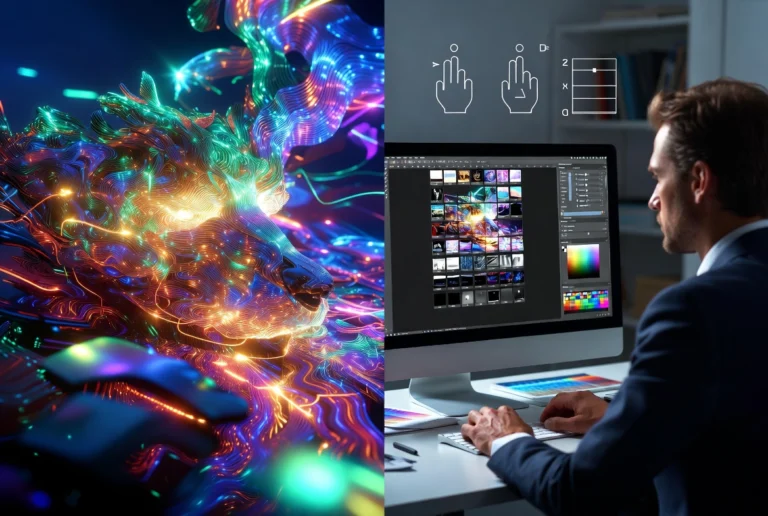
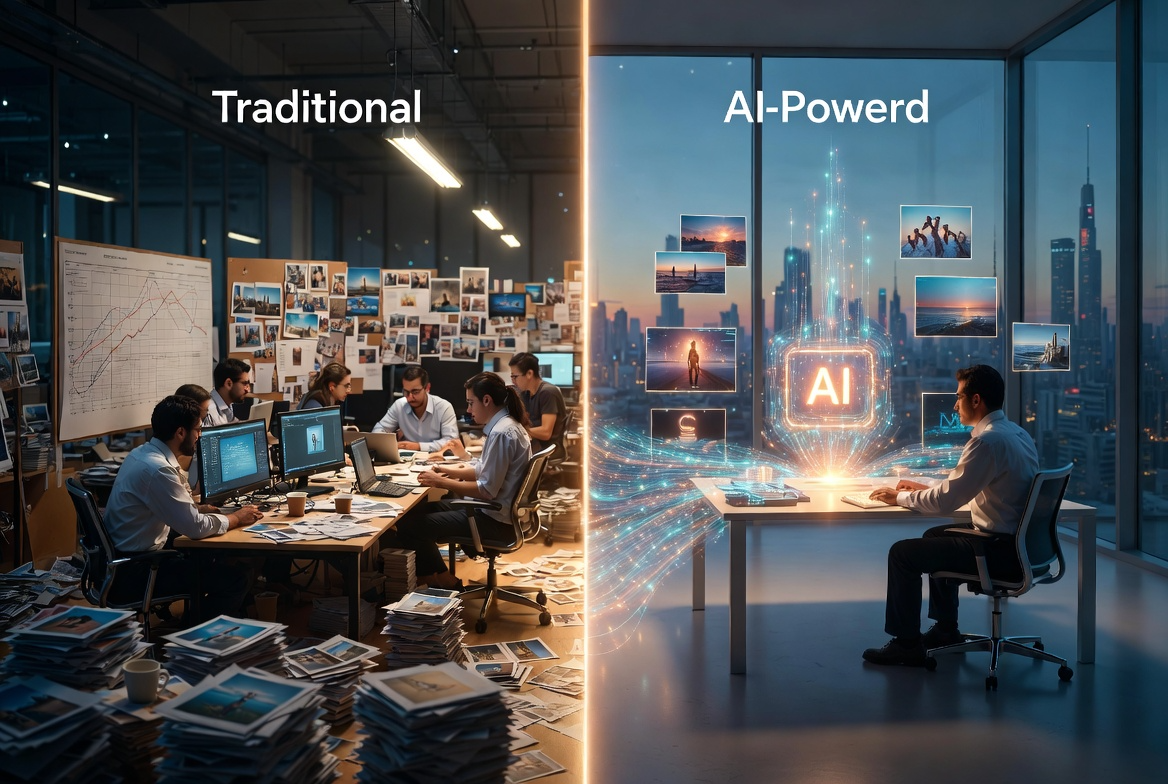
A global retail brand needed 50,000 unique product images for a new website launch. Six months ago, that would have required a team of photographers, editors, and project managers working for weeks. Today, they completed the entire project in four days using AI. This is not a hypothetical scenario. It is happening right now. The adoption of AI for enterprises is fundamentally changing how large organizations produce visual content.
This guide explores how enterprise-level businesses are using artificial intelligence to create images, videos, and graphics at scale. We will look at real implementation strategies, cost savings, quality considerations, and the unique challenges that large organizations face when adopting AI tools. Whether you are a CMO, creative director, or digital transformation lead, you will leave with a practical understanding of how AI can transform your visual content pipeline.
What Does AI for Enterprises Mean in Visual Content?
AI for enterprises is different from consumer AI tools. A marketing manager using Midjourney to create a social media graphic is one thing. A multinational corporation integrating AI image generation into their content management system is another. Enterprise AI involves scale, security, compliance, and integration with existing workflows.
Large organizations need tools that can handle thousands of requests simultaneously, maintain brand consistency across millions of assets, and comply with data privacy regulations. Consumer-grade AI tools rarely meet these requirements. This is why dedicated enterprise platforms are emerging.
The Scale Problem: Why Enterprises Need AI
Consider the content demands of a typical enterprise. A global e-commerce company might need product images in dozens of sizes, formats, and backgrounds for different markets. A media organization might need thousands of unique article thumbnails every week. A real estate firm might need virtual staging for hundreds of properties daily.
Traditional visual content creation cannot keep up with these demands. Hiring enough photographers, designers, and editors is prohibitively expensive. Stock photo libraries lack specificity. This is where AI for enterprises solves a real business problem, not just a creative one.
Real Enterprise Use Cases
Here are specific ways large organizations are using AI to create visual content at scale.

E-commerce Product Photography at Scale
A fashion retailer with 100,000 SKUs needs consistent product images on white backgrounds, plus lifestyle shots for marketing. Using enterprise AI tools, they generate lifestyle variations automatically. One product photo becomes twenty different settings: a handbag on a beach, in a city, at a cafe, during autumn, winter, spring. The cost per variation drops from $50 to essentially zero.
Real Estate Virtual Staging
A national real estate firm stages thousands of empty properties each month. Professional virtual staging costs $50-100 per image. AI staging costs pennies. The quality is not identical, but for initial listings, it is good enough. The firm saves over $1 million annually while listing properties faster.
Media and Publishing
A news organization publishes hundreds of articles daily. Finding relevant, licensed images for every piece is time-consuming. They now use AI to generate custom illustrations and concept images for articles that do not need photorealistic accuracy. Production time drops by 60 percent.
Advertising and Marketing Campaigns
A global advertising agency creates hundreds of ad variations for A/B testing. Instead of shooting multiple versions, they generate them with AI. The winning concepts go to professional production. This approach reduces testing costs by 80 percent and shortens campaign launch time.
Key Benefits of AI for Enterprise Visual Content
Organizations that have successfully adopted AI report several measurable advantages.
Massive Cost Reduction
Enterprises report cost savings between 50 and 90 percent for visual content production, depending on the use case. The highest savings come from high-volume, repetitive tasks like generating product variations or social media assets.
Faster Time to Market
What once took weeks now takes days or hours. This speed allows enterprises to respond to market trends, launch seasonal campaigns, and test creative directions much faster than competitors.
Consistent Brand Execution
Enterprise AI tools can be trained on brand guidelines. They learn preferred color palettes, composition styles, and visual themes. This ensures that thousands of generated assets maintain consistent brand identity, something impossible to achieve with human creators at scale.
Personalization at Scale
AI enables true personalization. A travel company can generate unique destination images for each customer based on their preferences. A retailer can show product images that match the customer’s local environment. This level of personalization was previously impossible.
Challenges and Risks for Enterprises
Adopting AI for enterprises is not without difficulties. Here are the main challenges organizations face.
Legal and Copyright Uncertainty
As discussed in our previous guide, the legal status of AI-generated images remains unsettled. For enterprises with significant legal exposure, this is a major concern. Many large organizations are proceeding cautiously, using AI for internal or low-risk applications while awaiting clearer legal guidance.
Quality Control at Scale
AI tools produce inconsistent results. Some images are perfect. Others have bizarre artifacts, missing fingers, or nonsensical text. At enterprise scale, reviewing and filtering millions of generated images requires its own quality control infrastructure.
Integration with Existing Systems
Most enterprises have existing content management, digital asset management, and workflow systems. Integrating AI generation into these systems is non-trivial. It requires technical expertise and often custom development.
Brand Consistency
While AI can be trained on brand guidelines, maintaining consistency across millions of assets is challenging. Enterprises need robust prompt management, version control, and approval workflows.
Data Privacy and Security
Enterprises cannot upload proprietary images or customer data to public AI tools. This requires private, on-premise or dedicated cloud deployments, which are more expensive and complex to manage.
Implementation Framework for Enterprises
Based on case studies from organizations that have successfully adopted AI, here is a practical framework.
Phase 1: Pilot with Low-Risk Use Cases
Start with internal applications. Use AI to generate presentation images, internal communications graphics, or brainstorming visuals. These use cases carry little legal or brand risk and allow your team to learn the tools.
Phase 2: Develop Governance and Guidelines
Create clear policies. Which tools are approved? What prompts are allowed? How are outputs reviewed? Who owns the generated assets? Establish these rules before scaling.
Phase 3: Integrate with Existing Workflows
Build or buy integration tools that connect AI generation to your content management and approval systems. Automate quality checks where possible.
Phase 4: Scale to Customer-Facing Content
Once your processes are solid, expand to customer-facing applications. Start with non-critical assets like blog illustrations or social media graphics before moving to product images or advertising.
Phase 5: Continuous Optimization
AI tools improve rapidly. Continuously evaluate new models, update your prompts, and refine your quality control processes.
Enterprise AI Tools Comparison
| Tool | Enterprise Features | Security | Cost Model |
|---|---|---|---|
| Adobe Firefly | Creative Cloud integration, brand kits | High (licensed training data) | Subscription per user |
| DALL-E Enterprise | API access, custom fine-tuning | Moderate (pending lawsuits) | Usage-based pricing |
| Midjourney | Discord-based, limited enterprise features | Low (public by default) | Monthly subscription |
| Stable Diffusion (Enterprise) | Self-hosted, full control, custom models | Very high (private deployment) | Infrastructure + licensing |
Measuring ROI of AI for Visual Content
Enterprises need to justify technology investments. Here is how leading organizations measure the return on AI visual content tools.
Direct Cost Savings
Calculate your current cost per image for photography, design, and licensing. Compare to AI generation costs. For high-volume use cases, savings typically range from 50 to 90 percent.
Time Savings
Measure the time from creative brief to final asset delivery. AI reduces this from days to hours or minutes. For time-sensitive campaigns, this speed has significant value.
Increased Output
With AI, the same creative team can produce 5 to 10 times more visual assets. This increased capacity allows more A/B testing, personalization, and market experimentation.
Quality Metrics
Track engagement rates, click-through rates, and conversion rates for AI-generated versus traditionally created assets. In many cases, performance is comparable, and sometimes AI performs better due to increased variety and testing.
Future Trends in Enterprise AI Visual Content
Adopting AI for enterprises is not a one-time project. The technology is evolving rapidly. Here is what to expect.
Video Generation
AI video generation is advancing quickly. Within two to three years, enterprises will generate short video clips from text prompts. This will revolutionize social media content, advertising, and internal communications.
3D and Immersive Content
AI-generated 3D models and environments will enable virtual showrooms, product configurators, and immersive experiences at a fraction of current production costs.
Fully Integrated Workflows
AI will become embedded in content management systems, design tools, and marketing platforms. Creating AI-generated images will be as seamless as uploading a file today.
Legal Clarity
Within the next two years, courts will provide clearer guidance on copyright, training data, and commercial use. This will accelerate enterprise adoption.
Frequently Asked Questions
1. Is AI for enterprises ready for prime time?
Yes and no. For high-volume, low-stakes applications like product variations, blog illustrations, and social media graphics, absolutely. For mission-critical brand assets like hero images and product photography, many enterprises are still proceeding cautiously.
2. How much does enterprise AI image generation cost?
Costs vary widely. Self-hosted open-source models cost infrastructure only (thousands per month for large-scale deployment). Commercial enterprise APIs cost $0.002 to $0.04 per image, depending on volume and resolution. Most large enterprises spend between $10,000 and $100,000 annually on AI visual content tools.
3. Can I train AI on my brand’s existing images?
Yes. Many enterprise AI tools allow custom fine-tuning on your brand’s visual assets. This ensures generated images match your brand colors, style, and aesthetic. However, this requires technical expertise and careful data management.
4. What about copyright for enterprise-generated images?
The legal situation is still developing. In the US, pure AI outputs without human input have limited copyright protection. Heavily edited images may have partial protection. Enterprises should consult legal counsel and document their creative processes.
5. How do I convince leadership to invest in AI visual content?
Start with a small pilot in a low-risk area. Measure cost savings, time savings, and output increases. Present data, not hypotheticals. Show how competitors are adopting AI. Frame AI as a competitive necessity, not an optional experiment.
Conclusion: A Strategic Approach to AI for Enterprises
AI for enterprises is not a passing trend. It is a fundamental shift in how visual content is created at scale. The organizations that adopt strategically will gain significant competitive advantages in cost, speed, and personalization. Those that ignore it will fall behind.
However, successful adoption requires more than buying a tool license. It requires clear governance, integration with existing workflows, quality control processes, and a nuanced understanding of legal risks. Start with low-risk pilots. Measure results. Scale what works. And always remember that AI is a tool to augment human creativity, not replace it.
The enterprises that win will be those that combine the scale and efficiency of AI with the judgment, creativity, and legal oversight of human experts.