
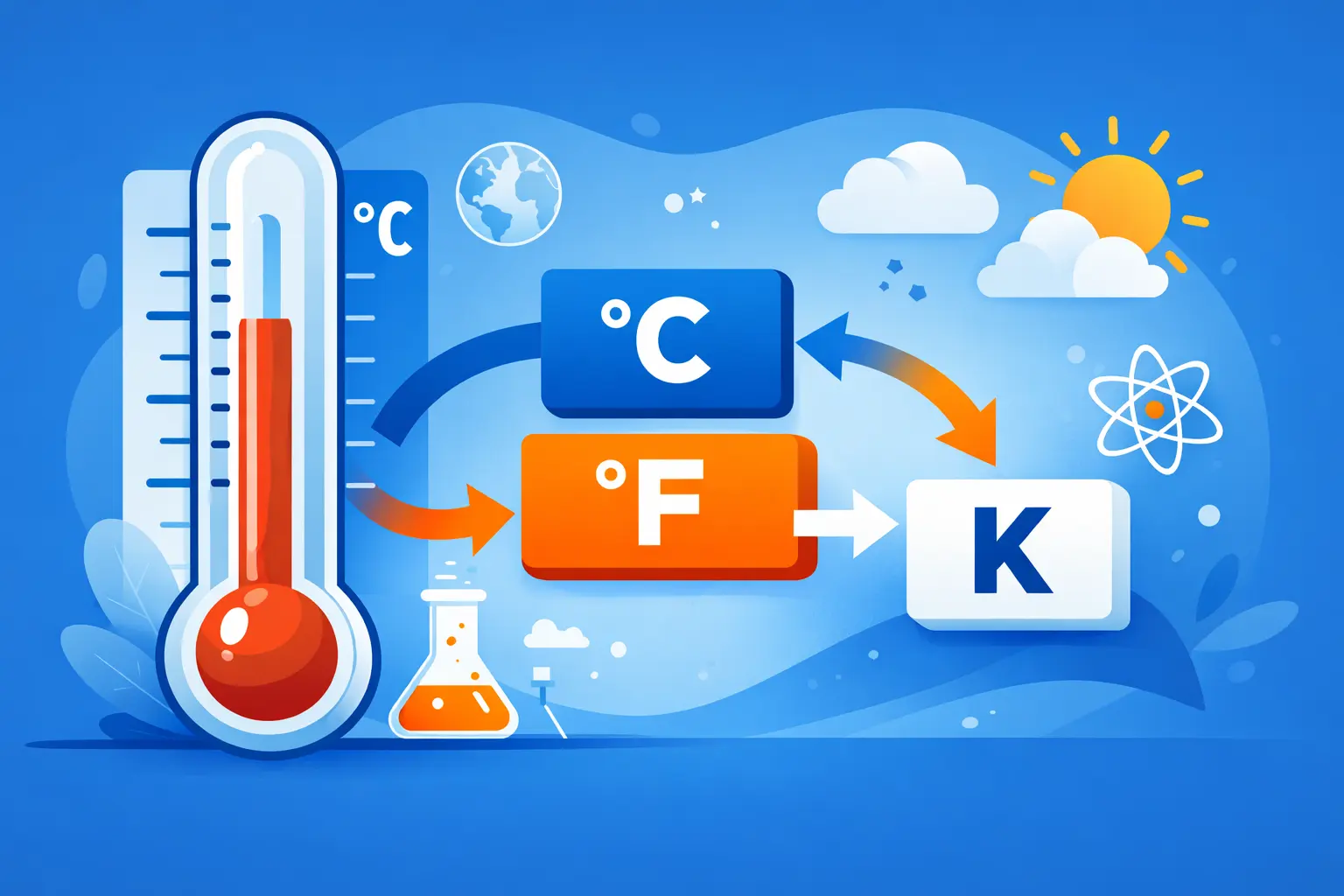
Have you ever been following a recipe from a European cookbook and wondered what 180°C means in Fahrenheit? Or perhaps you’ve traveled to the United States and felt confused when the weather forecast said 75°F. Temperature scales can feel like a foreign language, but understanding them is easier than you might think. Whether you’re cooking, traveling, studying science, or just curious about how the world measures heat, this guide will give you everything you need to confidently convert between Celsius, Fahrenheit, and Kelvin.
In this comprehensive guide, you’ll learn the history behind each temperature scale, the formulas for converting between them, step-by-step instructions for using conversion tools, real-life examples, common mistakes to avoid, and practical tips for everyday situations. By the end, you’ll be able to switch between scales with ease—no math anxiety required.
Convert Temperatures in Seconds!
Easily switch between Celsius, Fahrenheit, and Kelvin. Save time and get accurate results instantly with our interactive temperature converter.
Try the Celsius to Fahrenheit Tool →Why Temperature Conversion Matters
Temperature is one of the most fundamental measurements in daily life. It tells you how to dress for the day, how long to bake a cake, whether a fever is concerning, and even how scientific experiments should be conducted. But different parts of the world use different scales. Understanding how to convert between them isn’t just a party trick—it’s a practical skill that saves time, prevents mistakes, and helps you communicate across cultures.
Imagine you’re baking a French recipe that calls for an oven temperature of 200°C. If you set your American oven to 200°F, your cake will be a disaster. Or picture yourself traveling to Canada, where the forecast says 25°C. Is that shorts weather or sweater weather? A quick conversion tells you it’s a beautiful 77°F—perfect for outdoor plans.
Whether you’re a home cook, a student, a traveler, or a professional in science or engineering, mastering temperature conversion makes your life easier and more connected to the world around you.
The Three Main Temperature Scales: A Quick Overview
Before diving into conversions, it helps to understand what makes each scale unique. Each has its own history, reference points, and common uses.
Celsius (°C) – The Metric Standard
Celsius, also known as centigrade, is the most widely used temperature scale in the world. It was developed by Swedish astronomer Anders Celsius in 1742. The scale is based on the freezing and boiling points of water: 0°C is the freezing point, and 100°C is the boiling point at standard atmospheric pressure. This logical, decimal-based system makes it intuitive for everyday use and scientific applications alike.
Common uses: Weather forecasts outside the US, cooking in most countries, scientific research, and medicine.
Fahrenheit (°F) – The US Standard
The Fahrenheit scale was developed by German physicist Daniel Gabriel Fahrenheit in 1724. It sets the freezing point of water at 32°F and the boiling point at 212°F, creating a 180-degree separation. The scale was originally based on a mixture of ice, water, and salt (0°F) and the average human body temperature (approximately 96°F). Today, Fahrenheit remains the standard in the United States and a few other countries.
Common uses: Weather forecasts in the US, home thermostats, cooking temperatures in American recipes, and some medical applications.
Kelvin (K) – The Scientific Standard
Kelvin is the base unit of temperature in the International System of Units (SI). Unlike Celsius and Fahrenheit, Kelvin is an absolute scale, meaning it starts at absolute zero—the theoretical point where all molecular motion stops (0 K). There are no negative numbers in Kelvin. A change of 1 K is equivalent to a change of 1°C, making conversions between Kelvin and Celsius straightforward. Lord Kelvin (William Thomson) introduced the scale in 1848.
Common uses: Physics, chemistry, astronomy, engineering, and any scientific context where absolute temperature matters.
The Conversion Formulas: How to Convert Between Scales
While online tools make conversion instant, understanding the formulas gives you confidence and allows you to convert anywhere—even without internet access.
Celsius to Fahrenheit
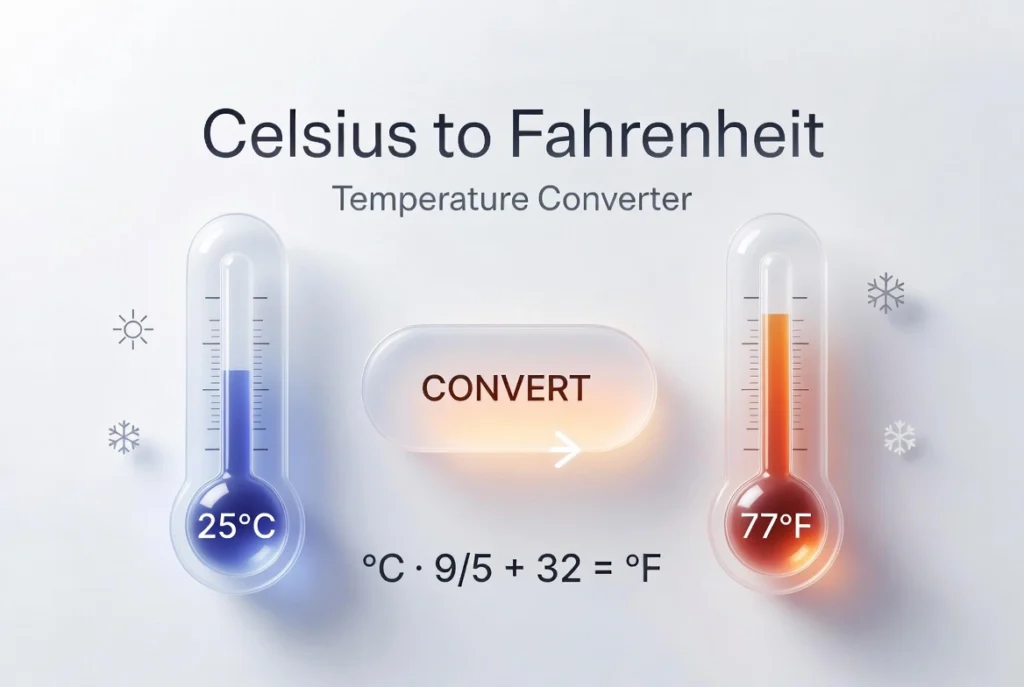
The formula is: °F = (°C × 9/5) + 32
Let’s break that down. Multiply the Celsius temperature by 9, divide by 5, then add 32. For example, to convert 25°C to Fahrenheit:
25 × 9 = 225, then 225 ÷ 5 = 45, then 45 + 32 = 77°F.
Fahrenheit to Celsius
The formula is: °C = (°F − 32) × 5/9
Subtract 32 from the Fahrenheit temperature, then multiply by 5, then divide by 9. For example, to convert 68°F to Celsius:
68 − 32 = 36, then 36 × 5 = 180, then 180 ÷ 9 = 20°C.
Celsius to Kelvin
The formula is simple: K = °C + 273.15
Since the Kelvin scale uses the same increments as Celsius, you just add 273.15. For example, 25°C equals 298.15 K.
Kelvin to Celsius
Reverse the formula: °C = K − 273.15
For example, 300 K equals 26.85°C.
Fahrenheit to Kelvin
Combine the two steps: first convert Fahrenheit to Celsius, then add 273.15. The direct formula is: K = (°F − 32) × 5/9 + 273.15
Kelvin to Fahrenheit
First convert Kelvin to Celsius, then to Fahrenheit: °F = (K − 273.15) × 9/5 + 32
If formulas aren’t your favorite way to work, don’t worry. A good temperature conversion tool handles all of these calculations instantly. The Spin Numbers Celsius to Fahrenheit Converter provides a clean, straightforward interface where you can enter any temperature and get the equivalent in all three scales with one click.
👉 Try the Spin Numbers Temperature Converter here and get accurate conversions in seconds.
Step-by-Step Guide: How to Use a Temperature Converter
Using an online temperature converter is straightforward, but here’s a step-by-step walkthrough to ensure you get accurate results every time.
Step 1: Identify Your Starting Temperature
Write down the temperature you want to convert, along with its scale (Celsius, Fahrenheit, or Kelvin). Be sure to note whether it’s a positive or negative number—negative temperatures are common in Celsius and Fahrenheit, especially in winter.
Step 2: Choose the Scale You Want to Convert To
Decide which scale you need for your situation. Cooking? You’ll likely need Fahrenheit (for US recipes) or Celsius (for European recipes). Science class? Kelvin might be required. Weather? Probably Celsius or Fahrenheit.
Step 3: Enter the Number into the Converter
Input your starting temperature into the converter. Most tools allow you to select the input scale from a dropdown menu. Double-check that you’ve selected the correct scale—confusing Celsius and Fahrenheit is the most common error.
Step 4: Read the Result
The converter will display the equivalent temperature in your chosen scale. Some tools also show all three scales at once, which is helpful for cross-referencing.
Step 5: Apply the Result to Your Situation
Now that you have the converted temperature, use it. Adjust your oven, pack your suitcase, or complete your science homework with confidence.
Real-Life Examples: When You Need Temperature Conversion
Temperature conversion isn’t just an academic exercise—it comes up constantly in everyday life. Here are some common scenarios where knowing how to convert (or having a converter handy) makes all the difference.
Example 1: Cooking and Baking
You find a wonderful recipe for chocolate cake online, but it’s from a British food blog. The oven temperature is listed as 180°C. If you’re in the US, you need to convert to Fahrenheit. Using the formula: 180 × 9/5 + 32 = 356°F. Most ovens round to 350°F or 375°F, so you’d set it to 350°F and check for doneness a few minutes later.
Example 2: Travel Planning
You’re planning a trip to Paris in July. The weather forecast says the high will be 28°C. Is that warm? Convert to Fahrenheit: 28 × 9/5 + 32 = 82.4°F. That’s a lovely summer day—pack shorts and a light jacket for the evenings.
Example 3: Science Class
A chemistry lab assignment asks you to calculate the temperature in Kelvin for an experiment. The room temperature is 22°C. Add 273.15 to get 295.15 K. Knowing this conversion ensures your experiment data is accurate.
Example 4: Medical Contexts
You’re traveling abroad and feel unwell. A local thermometer reads 38.5°C. Is that a fever? Convert to Fahrenheit: 38.5 × 9/5 + 32 = 101.3°F. Yes, that indicates a fever, so you know to seek medical attention.
Common Mistakes in Temperature Conversion
Even with the best intentions, errors happen. Here are the most frequent mistakes people make when converting temperatures—and how to avoid them.
Mistake 1: Forgetting the Order of Operations
When using the formulas, the order matters. For Celsius to Fahrenheit, you multiply first, then add 32. Doing the addition first will give you a wildly incorrect result. Always follow the formula exactly.
Mistake 2: Mixing Up the Formulas
It’s easy to reverse the formulas. Remember: for Celsius to Fahrenheit, you multiply by 9/5 and add 32. For Fahrenheit to Celsius, you subtract 32 first, then multiply by 5/9. A quick mnemonic: “C to F: multiply and add; F to C: subtract and multiply.”
Mistake 3: Rounding Too Early
If you’re doing manual calculations, avoid rounding intermediate steps. For example, when converting 100°F to Celsius: (100 – 32) = 68, 68 × 5 = 340, 340 ÷ 9 = 37.777… Round only at the final step to 37.8°C. Rounding too early can introduce errors.
Mistake 4: Confusing Negative Temperatures
Negative temperatures require extra attention. For example, converting -10°C to Fahrenheit: (-10 × 9/5) = -18, -18 + 32 = 14°F. It’s easy to make sign errors, so double-check your work.
Best Practices for Accurate Temperature Conversion
Whether you’re converting by hand or using a tool, these best practices will help you get reliable results every time.
Use a Reliable Converter for Critical Situations
If you’re baking a delicate cake or working on an important science project, use a trusted online converter. The Spin Numbers Temperature Converter is designed for accuracy and simplicity, giving you confidence in your results.
Understand the Context of the Temperature
Knowing whether you’re converting a weather temperature, an oven setting, or a scientific measurement helps you check if your result makes sense. If a weather forecast says 30°C and your conversion gives you 86°F, that’s plausible. If it gives you 200°F, you know something went wrong.
Memorize Key Reference Points
Having a few key conversions memorized helps you quickly sanity-check your results:
- 0°C = 32°F (freezing point of water)
- 10°C = 50°F
- 20°C = 68°F (comfortable room temperature)
- 30°C = 86°F (warm day)
- 37°C = 98.6°F (normal body temperature)
- 100°C = 212°F (boiling point of water)
Double-Check Your Input Scale
When using an online converter, it’s easy to accidentally select the wrong input scale. Always verify that you’ve chosen Celsius, Fahrenheit, or Kelvin correctly before hitting convert.
Beyond Basic Conversion: Understanding Temperature in Different Contexts
Temperature conversion becomes more nuanced when you consider how different fields use temperature scales. Here’s a deeper look at temperature in cooking, weather, science, and daily life.
Cooking Temperatures: Precision Matters
In cooking, a few degrees can mean the difference between a perfectly baked loaf and a burnt one. When converting oven temperatures, it’s often safe to round to the nearest 5°F or 10°F because oven thermostats aren’t perfectly precise. However, for candy making or sous vide cooking, precision matters more. In those cases, use exact conversions.
Weather: Relative Comfort
Weather temperatures are often reported in whole degrees. A difference of 1°C is noticeable but small (about 1.8°F). When traveling, a simple rule of thumb: if you’re comfortable with Celsius, subtract 30 and halve for a rough Fahrenheit equivalent. For example, 30°C becomes (30-30)/2 = 0? That’s not accurate. Better to use the actual formula or a converter for travel planning.
Science and Engineering: Kelvin’s Importance
In scientific contexts, Kelvin is essential because it’s an absolute scale. Many physical laws, like the ideal gas law, require temperatures in Kelvin. Converting from Celsius to Kelvin is simple (just add 273.15), but forgetting to convert is a common source of error in labs.
Medical Temperatures: Fever Thresholds
In most countries, a fever is defined as a body temperature above 37.5°C (99.5°F) or 38°C (100.4°F) depending on the measurement location. Knowing both scales helps when reading international medical information.
Security and Privacy When Using Online Temperature Converters
Temperature converters are among the safest online tools because they typically don’t require any personal information. However, it’s still wise to be mindful of a few points.
No Personal Data Needed
A reputable temperature converter should never ask for your name, email, or any other identifying information. The Spin Numbers Temperature Converter, like many simple tools, works entirely in your browser without storing any data.
Use HTTPS-Protected Sites
Look for the padlock icon in your browser’s address bar. This indicates the site uses encryption, which protects your data from being intercepted. Even for simple tools, this is a sign of a trustworthy website.
Be Cautious with Mobile Apps
If you download a temperature conversion app, check what permissions it requests. A basic converter should not need access to your contacts, location, or camera. When in doubt, use a web-based converter from a trusted source.
Quick Reference: Temperature Conversion Cheat Sheet
For those moments when you need a quick reference without doing math or reaching for a tool, here’s a handy cheat sheet of common temperatures:
- Absolute zero: -273.15°C = -459.67°F = 0 K
- Freezing point of water: 0°C = 32°F = 273.15 K
- Cool day: 10°C = 50°F
- Mild day: 15°C = 59°F
- Room temperature: 20°C = 68°F
- Warm day: 25°C = 77°F
- Hot day: 30°C = 86°F
- Very hot day: 35°C = 95°F
- Normal body temperature: 37°C = 98.6°F
- Boiling point of water: 100°C = 212°F = 373.15 K
FAQs About Temperature Conversion
1. Why are there different temperature scales?
Different scales emerged from different historical contexts and applications. Celsius was developed for a logical decimal system based on water’s properties. Fahrenheit was developed for practical weather and medical measurements. Kelvin was created for scientific precision with an absolute zero reference. Each scale has strengths that suit its primary use.
2. Which temperature scale is most commonly used worldwide?
Celsius is the most widely used scale globally. It’s the standard for weather forecasts, cooking, and scientific work in most countries. Fahrenheit is primarily used in the United States and a few other nations. Kelvin is used almost exclusively in scientific contexts.
3. What’s the easiest way to convert Celsius to Fahrenheit without a calculator?
A quick mental approximation: double the Celsius temperature and add 30. For example, 20°C doubled is 40, plus 30 equals 70°F. The exact conversion is 68°F, so this method gives you a close estimate. For cooking or precise needs, use the exact formula or a converter.
4. Can I convert temperatures using Google or my phone?
Yes. You can type “25°C to Fahrenheit” directly into Google Search, and it will display the conversion. Most smartphones also have built‑in conversion tools in their calculator apps or voice assistants. These are convenient and reliable for quick conversions.
5. Is Kelvin ever used in daily life?
Kelvin is rarely used in everyday contexts outside of science and engineering. You might encounter it in discussions about lighting (color temperature of light bulbs is sometimes given in Kelvin), extreme cold applications, or in science classes. For most daily activities, Celsius and Fahrenheit are sufficient.
6. How do I convert oven temperatures accurately?
For oven temperatures, use the exact conversion formula or a reliable converter. However, because oven thermostats vary, it’s acceptable to round to the nearest 5°F or 10°F. When in doubt, use an oven thermometer to verify the actual temperature inside your oven.
7. What is absolute zero and why is it important?
Absolute zero (0 K or -273.15°C) is the theoretical lowest possible temperature where all molecular motion stops. It’s important in physics because it serves as the foundation for the Kelvin scale, which is used in many scientific equations that require absolute measurements.
8. Are online temperature converters safe and private?
Yes, most reputable online temperature converters are safe. They typically don’t store any data and don’t require personal information. The Spin Numbers Temperature Converter, for example, processes all calculations in your browser without transmitting any data. Always use HTTPS websites for added security.
Conclusion: Mastering Temperature Conversion for Everyday Life
Temperature conversion might seem like a small skill, but it opens doors. It lets you follow recipes from any country, understand weather forecasts wherever you travel, succeed in science classes, and communicate clearly with people around the world. Whether you’re baking a French pastry, planning a trip to Canada, or helping a child with homework, knowing how to convert between Celsius, Fahrenheit, and Kelvin makes life easier.
You don’t need to memorize complex formulas or become a math expert. With a few key reference points, a basic understanding of the formulas, and a reliable converter like the Spin Numbers Temperature Conversion tool, you’ll be prepared for any temperature challenge that comes your way.
Remember: temperature is just a measurement, but understanding it connects you to the world. So next time you see a temperature in an unfamiliar scale, you’ll know exactly what it means—and you’ll have the tools to convert it with confidence.