

Roman Numerals 1 to 100: Chart, Rules + Free Converter
See roman numerals 1 to 100 in one clear chart, learn the three rules behind them, and find out why clocks show IIII instead of IV. Free converter inside.

By Said · November 2026 · 7-minute read
The clock in your hallway says IIII. Your textbook says IV. A quiz asks you to write 49, and half your class answers IL. Only one of those is a mistake, and it is probably not the one you think. This guide gives you the full chart of roman numerals 1 to 100, the three rules behind every number, and a free Roman numeral converter to check your answers.
Key Takeaways
- Every number in roman numerals 1 to 100 uses only five symbols: I, V, X, L and C.
- Three rules build all of them: add, repeat a symbol up to three times, and subtract once.
- 4 in roman numerals is IV, 9 is IX, 40 is XL and 90 is XC.
- The current year, 2026, is MMXXVI.
- You can check any number from 1 to 3999 with the free Roman numeral converter.
Roman Numerals 1 to 100 Chart
Start with the chart. It shows roman numerals 1 to 100 in ten rows of ten, so you can find any value in seconds.
| Numbers | Roman numerals |
|---|---|
| 1–10 | I, II, III, IV, V, VI, VII, VIII, IX, X |
| 11–20 | XI, XII, XIII, XIV, XV, XVI, XVII, XVIII, XIX, XX |
| 21–30 | XXI, XXII, XXIII, XXIV, XXV, XXVI, XXVII, XXVIII, XXIX, XXX |
| 31–40 | XXXI, XXXII, XXXIII, XXXIV, XXXV, XXXVI, XXXVII, XXXVIII, XXXIX, XL |
| 41–50 | XLI, XLII, XLIII, XLIV, XLV, XLVI, XLVII, XLVIII, XLIX, L |
| 51–60 | LI, LII, LIII, LIV, LV, LVI, LVII, LVIII, LIX, LX |
| 61–70 | LXI, LXII, LXIII, LXIV, LXV, LXVI, LXVII, LXVIII, LXIX, LXX |
| 71–80 | LXXI, LXXII, LXXIII, LXXIV, LXXV, LXXVI, LXXVII, LXXVIII, LXXIX, LXXX |
| 81–90 | LXXXI, LXXXII, LXXXIII, LXXXIV, LXXXV, LXXXVI, LXXXVII, LXXXVIII, LXXXIX, XC |
| 91–100 | XCI, XCII, XCIII, XCIV, XCV, XCVI, XCVII, XCVIII, XCIX, C |
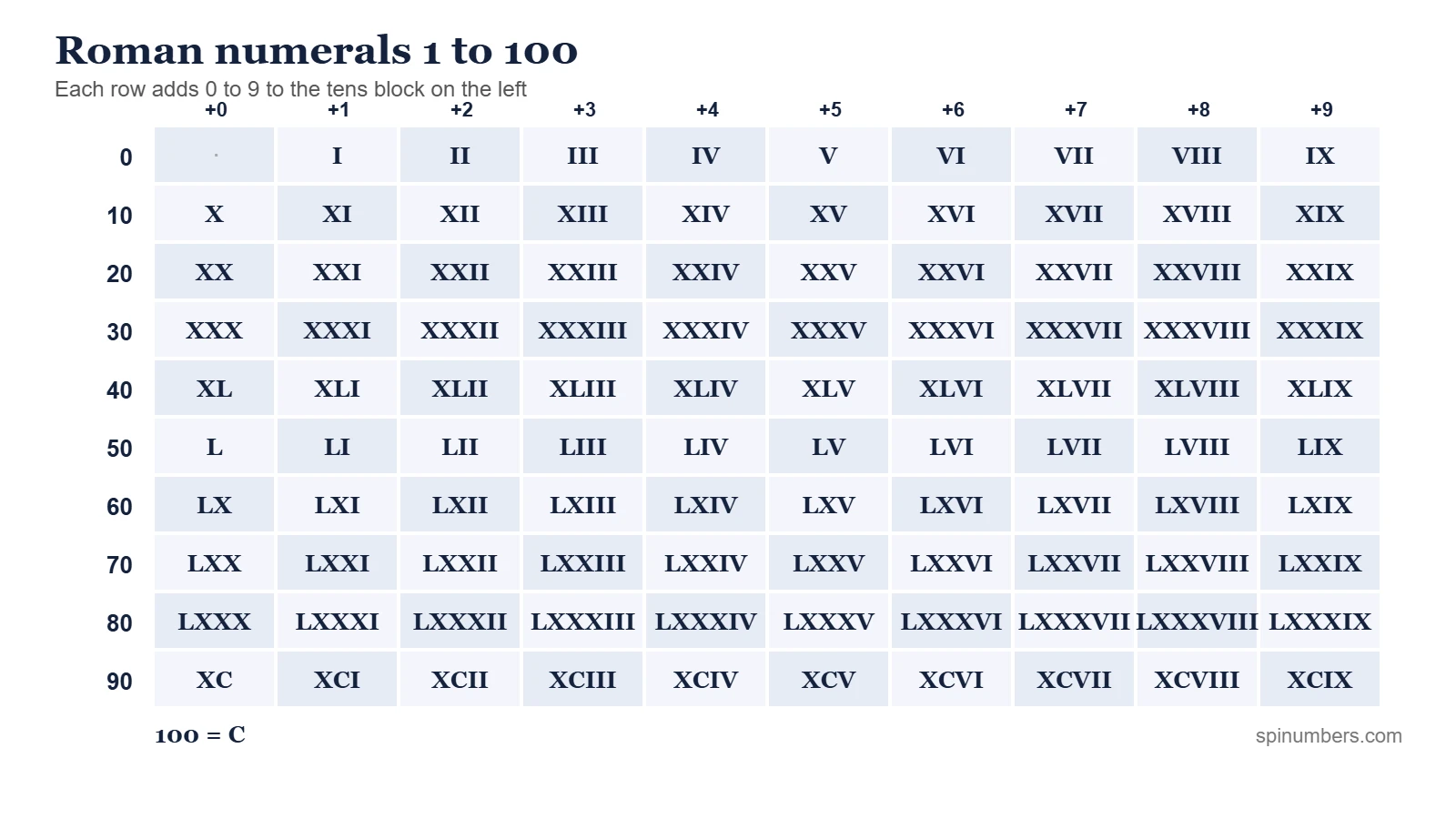
Look at the pattern. Each row repeats the same ending (I to IX) after a new “tens” block: X, XX, XXX, XL, L and so on. You do not need to memorize one hundred shapes. You need to memorize ten endings and ten tens blocks.
The Seven Symbols and the Rules Behind Roman Numerals 1 to 100
Roman numerals use seven symbols. Only the first five matter for roman numerals 1 to 100, because C already reaches 100:
- I = 1
- V = 5
- X = 10
- L = 50
- C = 100
- D = 500 and M = 1000 appear later
Three rules turn those symbols into every number:
- Add from left to right. VI is 5 + 1 = 6. XXV is 10 + 10 + 5 = 25.
- Repeat a symbol up to three times. III is 3, but you never write IIII in standard use. That is why 4 changes shape.
- Subtract when a smaller symbol sits before a larger one. IV is 5 − 1 = 4. XC is 100 − 10 = 90.
The “why” behind rule 3 saves you from the most common errors. Only I, X and C can subtract, and each one subtracts from only the next two larger symbols. So I goes before V or X, X goes before L or C, and C goes before D or M. V, L and D never subtract, which is why 45 is XLV and never VL.
Roman Numbers 1 to 10 and 4 in Roman Numerals
The first ten numbers teach you the whole system, and they set the pattern for all of roman numerals 1 to 100. I, II and III repeat the symbol. Then 4 hits the limit of three repeats, so you subtract: IV. After V, you add again: VI, VII and VIII. At 9 you subtract again: IX. Then X starts the next block.
The “4th in roman numerals” works the same way. You write the number as IV and add an ordinal ending in English, as in “the IVth century”. Most writers skip the ending and let the context carry it.
To read any number, scan left to right and look for a small symbol before a larger one. Group that pair first, then add everything else. For XLIV, group XL (40) and IV (4) to get 44.
Current Year in Roman Numerals (2026 = MMXXVI)
Break 2026 into thousands, tens and ones: MM (2000) + XX (20) + VI (6) = MMXXVI. Next year, 2027, becomes MMXXVII.
You still see roman digits in places that want a formal feel, and roman numerals 1 to 100 cover most of those uses, from chapter numbers to outline levels. The NFL began labeling the Super Bowl with Roman numerals around Super Bowl V in 1971, and the game in February 2026 was Super Bowl LX. Film and television studios often print copyright years the same way. Book prefaces and outlines still use them for page and section numbers.
Pro Tips for Reading Roman Numeral Numbers
- Anchor on X, L and C. Remember 10, 50 and 100 first. Every other number sits next to one of these anchors.
- Split before you convert. Write 78 as 70 + 8, then convert each part: LXX + VIII = LXXVIII. This works for any number up to 3999.
- Check by adding back. Convert your answer in your head. If XLIX does not give you 40 + 9, you made an error. This habit is the fastest way to practice roman numerals 1 to 100 without a worksheet.
- Treat Roman numerals as a count, not as place value. There is no zero, so you cannot “shift” digits the way you do with 10, 100 and 1000. The scholar Bede used the word nulla for zero in his work on time reckoning around 725, but the symbol never joined the standard system.
Common Mistakes With Roman Numerals 1 to 100
Most errors come from breaking the subtraction rule. If you can name which symbol subtracts from which, you will avoid almost every wrong answer below.
- Writing IL for 49. You cannot subtract I from L. Break 49 into 40 + 9 and write XLIX.
- Writing IIX for 8. Subtraction places a smaller symbol before a larger one, and only for the pairs the rules allow. Write 8 as VIII.
- Writing XXXX for 40. You can repeat X only three times. Use XL.
- Using V, L or D to subtract. VX is not 5, and LC is not 50. Only I, X and C subtract.
Check Your Answers With the Free Converter
Type any number from 1 to 3999 into the Roman numeral converter and it gives you the Roman form instantly. It also works backward, so you can paste XLIX and see 49. Use it to check homework, a clock face or a copyright line. If you are learning roman numerals 1 to 100, try ten random numbers by hand first, then confirm them with the tool.
Frequently Asked Questions
What are roman numerals 1 to 100?
They are the numbers I to C. They use five symbols: I (1), V (5), X (10), L (50) and C (100). You build every number by adding, repeating a symbol up to three times, or subtracting one symbol from the next two larger ones. The chart above lists all one hundred, from I through XCIX to C. Learn the ten endings first and roman numerals 1 to 100 become a short exercise instead of a memory test.
What is 4 in roman numerals?
Standard writing uses IV, which means 5 minus 1. The shape avoids repeating I four times, which breaks the three-repeat rule. Some clocks use IIII instead, a traditional exception. When someone asks for the “4th in roman numerals”, the answer is still IV.
What is 2026 in roman numerals?
2026 is MMXXVI. Write MM for 2000, XX for 20 and VI for 6. This pattern works for any year: split the number into thousands, hundreds, tens and ones, then convert each part.
Is there a zero in roman numerals?
No. The system has no symbol for zero, because Romans used it to record counts rather than do arithmetic. Some medieval writers, including Bede around 725, used the Latin word nulla in tables. Modern writers use the digit 0 or the word zero instead.
Why do some clocks use IIII instead of IV?
Clockmakers have used IIII for centuries. Horology references list several explanations, including visual balance with VIII on the opposite side of the dial and simple tradition. No single reason is proven. Both forms are acceptable on a clock, but standard writing elsewhere uses IV, including every chart of roman numerals 1 to 100.
Conclusion
Roman numerals 1 to 100 look like a hundred shapes, but they come from five symbols and three rules. Learn the anchors X, L and C, split each number into tens and ones, and check your work by adding it back. When you want a fast answer, paste your number into the free Roman numeral converter and move on with confidence.
Sources
- Encyclopaedia Britannica, “Roman numeral” (reference entry on symbols and rules).
- Bede, De temporum ratione (around 725), on the use of nulla for zero.
- National Football League, Super Bowl history (Roman numerals from Super Bowl V, 1971).