
By Spin Numbers · Last Update June 2026 . 10 Minute Read
You have spent eleven minutes comparing two nearly identical coffee makers. You know both will work. The price difference is negligible. Yet you cannot decide.
Most people assume that better decisions come from more thinking: more analysis, more comparison, more time spent weighing options. But decades of cognitive research tell a different story. In many everyday situations, the longer you deliberate, the worse your decision becomes. And a simple random number generator, used correctly, produces faster and equally good outcomes without the cognitive cost.
This is not a personal flaw. It is a structural limitation of human cognition that affects everyone regardless of intelligence or experience. Understanding when to stop thinking, and how to use a random number as a deliberate decision tool, is one of the most practical cognitive skills you can develop.
Table of Contents
The Science Behind Decision Fatigue
In 2008, psychologist Roy Baumeister and colleagues published landmark research on ego depletion, the idea that self-control, willpower, and decision quality all draw from the same limited cognitive resource. As that resource depletes over the course of a day, the quality of decisions declines in measurable ways.
A well-known real-world illustration comes from a 2011 study published in the Proceedings of the National Academy of Sciences, which analyzed over 1,100 parole board decisions in Israeli courts. Judges granted parole in roughly 65 percent of cases at the start of the day. By late morning, after a series of consecutive decisions, that rate dropped close to zero before recovering after a food break. The content of the cases had not changed. The judges had simply exhausted their cognitive resources.
For everyday decisions, the consequence is subtler but equally real. The more choices you make throughout the day, the harder each subsequent choice becomes, including trivial ones. For a deeper look at how this pattern develops across a full day, the guide on decision fatigue explains the mechanisms and practical responses in detail.

The Hidden Problem: False Complexity
Not all decisions deserve the same cognitive effort, yet most people treat them as if they do.
Choosing a career, making a significant investment, or deciding where to live requires careful, deliberate thinking. Choosing what to eat for lunch, which task to do first, or who goes first in a game does not.
Psychologist Barry Schwartz explored this phenomenon extensively, arguing that an abundance of options does not increase satisfaction. It increases anxiety. When every decision feels equally significant, people experience what can be called false complexity: they manufacture difficulty in situations where none meaningfully exists.
The result is a predictable and costly pattern: time wasted on low-stakes decisions, increased stress and cognitive load, delayed action even when any choice would be acceptable, and reduced mental capacity for the decisions that actually matter.
Recognizing false complexity is the first step. Knowing what to do about it is the second.
The Decision Threshold Principle
Here is the core idea that changes how you approach low-stakes decisions:
Once all available options meet your minimum acceptable standard, further comparison produces diminishing returns.
If every option on the table is good enough, the difference between them is smaller than the cost of continued deliberation. At that point, the best decision is simply the one that gets made quickly, without extended analysis and without regret.
This is not a rationalization for laziness. It is a deliberate efficiency principle. You are not skipping the analysis. You are recognizing that the analysis is already complete, and that generating a random number to resolve the remaining choice is the rational next step.

A Practical Framework for Using a Random Number Generator as a Decision Tool
A random number generator is not a replacement for thinking. It is a tool you deploy after thinking, once options have been evaluated and filtered down to those that are genuinely acceptable.
Step 1: Filter. Remove Unacceptable Options
Before introducing any random number, apply your criteria. Eliminate any option that does not meet your minimum standard. This is where your judgment and expertise matter most. After this step, only acceptable options remain in the pool.
Step 2: Assign. Number Your Remaining Options
Assign each remaining option a number starting from 1. If you have three options, your range is 1 to 3. If you have seven options, it is 1 to 7. The range is specific to your situation and the number of options that survived the filter.
Step 3: Commit. Generate Once and Follow Through
Use a random number generator to produce one number. Commit to the result immediately. Re-generating until you get a preferred outcome defeats the purpose entirely. At that point it is no longer randomness. It is a disguised preference.
The commitment step is where most people fail. If you find yourself wanting to regenerate, that resistance is useful information. It reveals a preference you had not consciously acknowledged, which brings us to one of the most underappreciated benefits of this method.
A Real-World Scenario: Task Assignment in a Small Team
Consider a startup team of five people facing three equally urgent tasks before a product launch: writing documentation, testing a new feature, and updating the marketing page. All tasks are important. No task is clearly better or worse for any particular team member. Everyone is qualified to handle any of them.
Without a structured approach, the discussion typically follows a familiar and inefficient pattern. People hesitate to self-assign, not wanting to appear to take the easiest task. Attempts at fairness lead to circular conversation. Someone tries to rationalize why one task should go to a specific person, introducing bias. The discussion takes 15 to 25 minutes and leaves some team members feeling the outcome was not entirely fair.
Now consider the alternative. The team agrees in advance that any of these tasks is acceptable for any team member. They assign numbers 1 through 5 to team members and numbers 1 through 3 to tasks. They use a random number generator to create the assignments in under two minutes.
The outcome is faster, bias-free, and perceived as fair by the entire team. No one can question the result because no one influenced it. The team moves immediately into execution.
Research in organizational behavior consistently shows that perceived fairness in process, not just outcomes, is a significant driver of team trust and performance. A random allocation, when agreed upon in advance, satisfies this criterion naturally and without negotiation.
The Emotional Feedback Effect: Randomness as a Diagnostic Tool
One of the most underappreciated benefits of using a random number is what it reveals about your own preferences.
When a random result appears, your immediate emotional reaction is almost always honest. There is no time to rationalize or construct a narrative. You feel something before you think about it.
If you feel relief or satisfaction, the result confirms you were genuinely comfortable with all options and can move forward cleanly. If you feel disappointment or resistance, the random number has done something valuable: it has surfaced a real preference that your deliberate analysis had failed to identify.
In the second case, you can act on that preference directly rather than pretending the choice was neutral. Used this way, a random number generator is not just a decision tool. It is a structured form of self-reflection that surfaces information deliberation alone often misses.
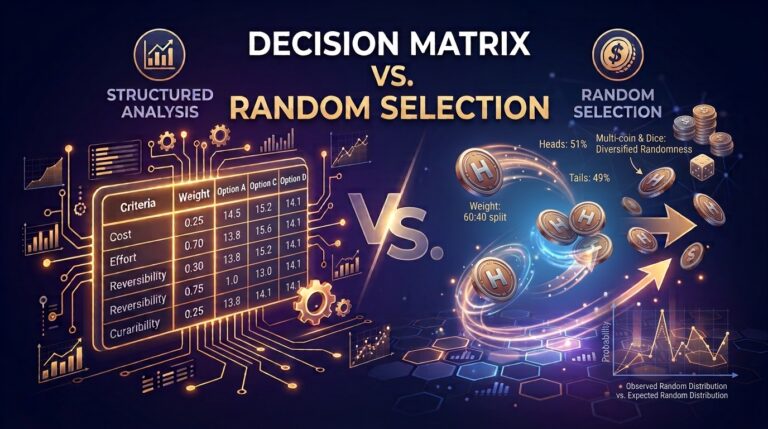
Random Selection vs. Traditional Decision Methods
| Method | Best For | Key Limitation | Speed |
|---|---|---|---|
| Systematic analysis | High-stakes, complex decisions | Slow and cognitively expensive | Low |
| Intuition | Familiar situations with experience | Subject to bias and inconsistency | High |
| Group consensus | Decisions affecting multiple stakeholders | Slow, prone to social pressure | Low |
| Random number selection | Low-stakes decisions between equal options | Ineffective when options are not equal | Very high |
No single method is universally best. Matching the method to the type of decision is what produces good outcomes consistently. For a broader comparison of tools and when to apply them, the guide on randomizers for decision making covers the full range of situations and appropriate tools.
When to Use a Random Number for Decision-Making
- Group task allocation when all options are acceptable and fairness is a priority
- Daily routine choices: what to eat, what to work on first, what to watch
- Tie-breaking when deliberation has produced no clear winner
- Games and selection processes where impartiality is required
- Breaking creative blocks when any starting point is genuinely acceptable
When Not to Use a Random Number
- Financial decisions: investments, major purchases, contracts
- Medical choices: treatment options, medication decisions
- Long-term personal commitments: career changes, relationships, relocation
- Decisions where options are not equal: if one option is clearly better, randomness only introduces unnecessary risk
The principle is straightforward. A random number is a tool for efficiency in low-stakes situations where options are genuinely equivalent. It should never substitute for responsibility in high-stakes ones.
Common Mistakes That Undermine the Method
Re-generating to get a preferred result. If you generate random numbers until you get the outcome you wanted, you are not using randomness. You are using it as a prop for a decision you already made. Commit to the first result.
Skipping the filter step. A random number only works correctly when every option in the pool is genuinely acceptable. If you include options you would not actually be satisfied with, you are setting up for regret regardless of the outcome.
Ignoring your emotional reaction. If you feel strong resistance to the result, that is data. Either commit and examine the resistance afterward, or acknowledge the hidden preference and decide consciously. Do not simply re-generate.
Overusing the method. A random number generator is a targeted tool, not a default for every choice. Applying it to decisions that genuinely require careful thought is a form of avoidance, not efficiency.
Frequently Asked Questions
Is a digital random number generator truly random?
Standard online tools use pseudo-random number generators, which produce sequences through deterministic mathematical algorithms seeded by dynamic system inputs such as millisecond timestamps. The sequences are statistically indistinguishable from physical randomness for all practical human purposes. For selecting between options, assigning tasks, or resolving everyday decisions, a pseudo-random number is entirely sufficient. The distinction between pseudo-random and true random matters only in cryptographic or scientific contexts. For a detailed explanation of the difference, see the guide on pseudo random vs true random.
Does this method work for group decisions?
Yes, and it frequently outperforms extended group consensus processes when all options are genuinely equivalent. The critical requirement is that all participants must explicitly agree on which options pass the filter before any random number is generated. Once the group establishes that every remaining option is acceptable, a random number generator eliminates bias, status asymmetry, and internal gridlock. Because the output is produced without human influence, it provides an immediate and undisputed path toward shared execution.
What if I regret the outcome?
Immediate post-decision discomfort is a normal response to the closing of alternatives. To evaluate it usefully, identify the nature of the discomfort. If it is minor disappointment that one acceptable option won over another, commit to the result and move forward. If it is strong resistance that feels disproportionate to the stakes, the random number has revealed a hidden preference your deliberate analysis had not surfaced. In that case, step back, acknowledge the preference, and decide consciously. The random number served its diagnostic purpose even if you do not follow through on the result.
How is this different from just flipping a coin?
The underlying principle is identical: offloading a low-stakes choice to an unbiased, non-human selector. The practical difference is scale. A coin flip is limited to two options. A random number generator scales across any number of options. Whether you are distributing seven tasks among a team, selecting from a list of ten acceptable options, or assigning roles in a group activity, a random number handles the complexity that a coin cannot.
Conclusion
The goal of good decision-making is not to spend the maximum amount of time on every choice. It is to allocate cognitive effort appropriately, investing it where it matters and conserving it where it does not.
When your options are already acceptable, continued deliberation is not due diligence. It is a drain on the cognitive resources you need for decisions that genuinely require careful thought.
In those moments, generating a random number is not a surrender to chance. It is an efficient, research-supported tool for people who understand when to stop optimizing and start acting.
References
Baumeister, R. F., Bratslavsky, E., Muraven, M., & Tice, D. M. (1998). Ego depletion: Is the active self a limited resource? Journal of Personality and Social Psychology, 74(5), 1252-1265. https://doi.org/10.1037/0022-3514.74.5.1252
Danziger, S., Levav, J., & Avnaim-Pesso, L. (2011). Extraneous factors in judicial decisions. Proceedings of the National Academy of Sciences, 108(17), 6889-6892. https://doi.org/10.1073/pnas.1018033108
Lind, E. A., & Tyler, T. R. (1988). The social psychology of procedural justice. Plenum Press.
Schwartz, B., Ward, A., Monterosso, J., Lyubomirsky, S., White, K., & Lehman, D. R. (2002). Maximizing versus satisficing: Happiness is a matter of choice. Journal of Personality and Social Psychology, 83(5), 1178-1197. https://doi.org/10.1037/0022-3514.83.5.1178