By Spin Numbers · Last Update June 2026 . 10 minute Read
You wake up sharp. Decisions come easily. By mid-afternoon, you are staring at a menu for five minutes, unable to pick a meal. By evening, you are agreeing to things you would have questioned in the morning. By midnight, you have bought a subscription you did not need and will regret tomorrow.
This is not a personality flaw. Decision fatigue is a measurable cognitive pattern that affects everyone regardless of intelligence or experience, and understanding it is the first step toward managing it.
What Decision Fatigue Actually Is
Decision fatigue is the measurable decline in decision quality that occurs after a person has made many decisions in succession. The more choices you make throughout the day, the worse each subsequent decision tends to be, not because you become careless, but because the cognitive resources required for evaluation genuinely deplete over time.
The concept is rooted in research by psychologist Roy Baumeister, who proposed that self-control and decision-making draw from a shared cognitive resource. When that resource depletes, decision quality drops in two predictable ways: people either make impulsive choices to end the discomfort of deciding, or they avoid deciding altogether and default to whatever requires the least effort.
A widely cited 2011 study published in the Proceedings of the National Academy of Sciences examined over 1,100 parole board decisions made by Israeli judges across a full working day. Prisoners who appeared early in the morning received parole approximately 65 percent of the time. Those who appeared later, after the judges had made many consecutive decisions, received parole far less often, sometimes close to zero percent. The cases themselves had not changed. The judges had simply run low on cognitive resources.
The implications extend well beyond courtrooms. Doctors make different prescribing decisions late in the day than early. Managers make different hiring assessments before and after lunch. Consumers make different purchases at the end of a long shopping session than at the beginning.

Why Decision Fatigue Happens: The Cognitive Cost of Choosing
Every decision requires cognitive effort, even small ones. You evaluate options, weigh consequences, consider preferences, and commit to a choice. This process consumes mental energy whether the decision is trivial or significant.
The core problem is that the brain does not distinguish well between decision types. Choosing what to have for breakfast costs cognitive resources in roughly the same way as choosing which project to prioritize. By treating all decisions as roughly equivalent in effort, the brain depletes its available resources faster than most people realize.
Barry Schwartz, in his research on what he called the paradox of choice, identified a related mechanism: more options do not make decisions easier. They make them harder. The effort of evaluating each additional option adds to cognitive load, which accelerates the depletion effect. A menu with 40 items is not more helpful than one with 10. It is more exhausting.
This is also why decision fatigue is not simply about making hard decisions. A day filled with dozens of trivial choices, what to wear, what to eat, which email to answer first, which route to take, can deplete cognitive resources just as thoroughly as a day spent on genuinely complex problems.
How to Recognize Decision Fatigue in Yourself
Decision fatigue rarely announces itself clearly. Most people experience it as a vague difficulty concentrating, a tendency to default to whatever is easiest, or an unusual level of irritability around minor choices.
Specific signs include:
- Avoiding decisions by postponing them indefinitely
- Choosing whatever someone else suggests without evaluating it yourself
- Making impulsive choices simply to end the discomfort of deliberating
- Feeling disproportionately stressed or irritable about options that would normally feel minor
- Defaulting to the status quo or the most familiar option regardless of whether it is actually the best one
The timing of these patterns matters as much as the patterns themselves. If they appear consistently in the afternoon or evening after a day of heavy cognitive activity, decision fatigue is the most likely explanation.
Practical Ways to Reduce Decision Fatigue
Make Important Decisions Earlier in the Day
Cognitive resources are highest in the morning for most people. Scheduling significant decisions, creative work, and complex evaluations early in the day takes advantage of peak mental capacity. This is not simply productivity advice. It is a direct application of what the research on decision fatigue predicts: the same decision made at 9 a.m. and at 4 p.m. is likely to produce different outcomes, and the morning version is more likely to reflect your actual judgment.
Reduce the Number of Decisions You Make
The most direct way to reduce decision fatigue is to make fewer decisions. Standardizing recurring choices eliminates them from your daily cognitive load entirely. Fixed meal plans, consistent morning routines, and pre-set defaults all reduce the number of active decisions you face before reaching the ones that actually matter.
This is the reasoning behind the famously simple wardrobes of people like Barack Obama and Steve Jobs, both of whom described eliminating clothing decisions as a deliberate strategy to preserve cognitive capacity for higher-stakes choices. The logic is not about fashion. It is about cognitive budgeting.
Use Structured Tools for Low-Stakes Decisions
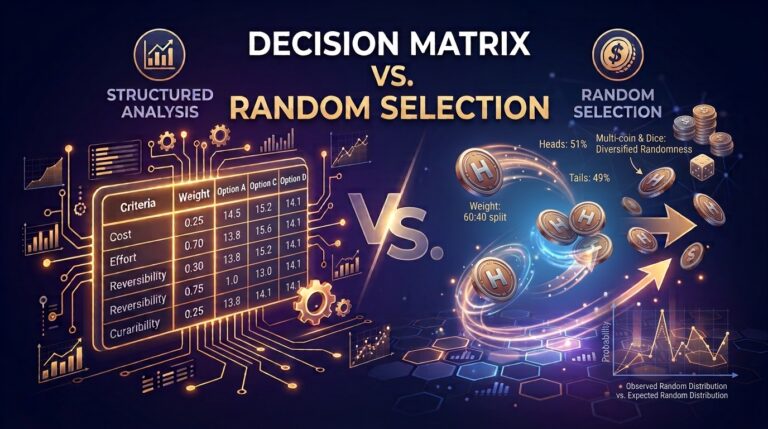
For decisions where options are genuinely equal, continued deliberation is a waste of cognitive resources. If both options are acceptable, the cost of choosing either one is minimal. The cost of continued deliberation, however, is real and cumulative.
A coin flip or a random decision resolves these instantly, preserving mental energy for decisions that actually require careful thought. Using a random tool in this context is not lazy. It is an accurate assessment of where cognitive effort adds value and where it does not. When the outcome genuinely does not matter, the deliberation genuinely does not help.
Take Breaks Before High-Stakes Decisions
The Israeli judges study revealed something practically important: parole rates recovered after meal breaks. A pause that includes food, rest, or a change of context partially restores cognitive capacity. If you know an important decision is coming, schedule it after a break rather than at the end of a long sequence of smaller choices. The break is not a reward. It is a functional reset.
Set Decision Deadlines
Open-ended decisions, those with no defined endpoint or deadline, consume cognitive resources every time they resurface in your thinking. The decision is never fully set aside because it remains unresolved. Setting a specific time to decide and committing to it removes the recurring mental overhead of an unresolved choice and prevents the low-grade depletion that accumulates from carrying multiple open decisions simultaneously.
Decision Fatigue in Group Settings
Decision fatigue compounds in groups. When multiple people are simultaneously depleted, discussions stall, default to the most vocal participant, or produce decisions that no one is fully satisfied with. The group dynamic adds a social layer to the cognitive one: depleted people are more likely to defer, agree prematurely, or disengage rather than contribute meaningfully.
Scheduling group decisions earlier in the day reduces this effect significantly. Using a structured framework, filtering options first, agreeing on a decision method, then executing it visibly, shortens the process and reduces the cognitive load on each participant.
For groups that have already narrowed options to choices that are equally acceptable, a random tool resolves the decision without requiring additional deliberation from already-depleted participants. This is particularly useful in team settings where prolonged discussion has produced consensus on the acceptable options but not on which specific one to choose. As covered in the guide on how to make a fair decision in a group without arguments, removing the final choice from individual judgment often produces faster and more satisfying outcomes for everyone involved.

What Decision Fatigue Is Not
Decision fatigue is not an excuse for poor judgment, and it is not evidence of a character flaw. It is a predictable cognitive pattern that can be anticipated and managed. Knowing it exists gives you the ability to schedule around it, reduce unnecessary decisions, and use the right tools at the right moments.
It also does not affect all decisions equally. Highly practiced decisions, automatic responses, and choices within areas of deep expertise are significantly less affected by depletion. A surgeon making a practiced incision late in the day is not as vulnerable as a manager evaluating an unfamiliar contract. The depletion effect is strongest on decisions that require active evaluation of unfamiliar or genuinely complex options.
Understanding this distinction matters because it changes how you respond. The goal is not to eliminate all decision-making after noon. It is to protect the decisions that require full cognitive engagement and to offload the ones that do not.
Frequently Asked Questions
Is decision fatigue the same as mental exhaustion?
They overlap but are not the same thing. Mental exhaustion is a broad state of cognitive depletion that can result from any sustained intellectual effort, including reading, learning, or problem-solving. Decision fatigue is specifically triggered by the repeated act of evaluating options and committing to choices. You can experience significant decision fatigue after a day of low-intensity shopping without feeling generally mentally exhausted, and you can feel mentally exhausted after deep reading without having made a single meaningful choice. The mechanisms are related but distinct.
Does decision fatigue affect everyone equally?
The underlying cognitive pattern is universal, but individual thresholds vary considerably. Factors including sleep quality, metabolic stability, baseline stress levels, and the degree to which a person has automated recurring decisions all influence how quickly decision fatigue sets in. People who have converted many recurring decisions into automatic routines effectively protect their cognitive resources for longer. This is not a fixed trait. It is a behavioral pattern that can be deliberately cultivated.
Can you train yourself to resist decision fatigue?
You cannot expand the brain’s absolute cognitive capacity through willpower. What you can do is change how that capacity is deployed. The most effective approach is behavioral: converting active, energy-intensive decisions into routines and automatic procedures. When a decision no longer requires active evaluation because it has been standardized, it stops drawing from your cognitive reserve. This is how experienced executives, surgeons, and high-performers in demanding fields sustain decision quality across long days. They do not have more cognitive resources. They waste fewer of them on decisions that do not require active thought.
How does a random tool help with decision fatigue?
A random selection tool functions as a cognitive offloading mechanism for low-stakes choices. When you face options with symmetrical outcomes, choosing between two equally rated restaurants, deciding which of two acceptable tasks to start first, the analytical mind often spends disproportionate energy trying to manufacture a preference that does not meaningfully exist. A random decision tool short-circuits this process by removing the evaluation stage entirely. The result is that your cognitive resources are preserved for decisions where genuine analysis produces a genuinely better outcome.
Conclusion
Decision fatigue is not a sign of weakness. It is a structural feature of how human cognition works under sustained load. The judges in the parole study were not careless or biased in any intentional sense. They were depleted, and their decisions reflected that depletion in ways that were measurable, consistent, and entirely predictable.
The practical response is not to try harder. It is to structure your day so that the decisions that matter most happen when your cognitive resources are fullest, and the decisions that do not matter are either standardized, delegated, or resolved with a tool rather than prolonged deliberation.
Start with one change: identify three small recurring decisions you make daily and eliminate them through a fixed default. Track whether your afternoon decision quality improves within two weeks. The evidence suggests it will.
References
Baumeister, R. F., Bratslavsky, E., Muraven, M., & Tice, D. M. (1998). Ego depletion: Is the active self a limited resource? Journal of Personality and Social Psychology, 74(5), 1252-1265. https://doi.org/10.1037/0022-3514.74.5.1252
Danziger, S., Levav, J., & Avnaim-Pesso, L. (2011). Extraneous factors in judicial decisions. Proceedings of the National Academy of Sciences, 108(17), 6889-6892. https://doi.org/10.1073/pnas.1018033108
Hagger, M. S., Chatzisarantis, N. L. D., Alberts, H., Anggono, C. O., Batailler, C., Birt, A. R., … Zwienenberg, M. (2016). A multilab preregistered replication of the ego-depletion effect. Perspectives on Psychological Science, 11(4), 546-573. https://doi.org/10.1177/1745691616652873
Schwartz, B., Ward, A., Monterosso, J., Lyubomirsky, S., White, K., & Lehman, D. R. (2002). Maximizing versus satisficing: Happiness is a matter of choice. Journal of Personality and Social Psychology, 83(5), 1178-1197. https://doi.org/10.1037/0022-3514.83.5.1178