By Spin Numbers · Last Update June 2026 · 10 minute read
Cold calling in the classroom is one of the most consistently effective participation strategies available to teachers, and one of the most frequently misunderstood. You ask a question. Eight hands go up. You call on a student with a raised hand. The other twenty-two students exhale quietly, relieved they do not have to think anymore.
That moment of collective relief is the problem. Cold calling in the classroom, when implemented with a visible random selection tool, eliminates that relief entirely and replaces it with the kind of sustained attention that produces measurable learning gains. This guide explains why random selection is the most effective and fairest way to implement cold calling, how to set it up, and what to do when it does not go smoothly.
Table of Contents
What the Research Says About Cold Calling in the Classroom
Doug Lemov, in “Teach Like a Champion,” identifies cold calling as one of the most consistently effective techniques used by high-performing teachers across all grade levels and subjects. The core mechanism is accountability: when students know they can be called on at any moment regardless of whether they raise their hand, they maintain active engagement with the material throughout the lesson rather than waiting for it to end.
Lemov distinguishes between cold calling that feels punitive and cold calling that feels like a normal part of classroom culture. The difference is not the technique itself but how it is framed and applied over time. Random selection, run visibly and consistently, removes the punitive dimension entirely because students understand the process is impartial rather than targeted.
Research by Mary Budd Rowe on wait time, published in the Journal of Research in Science Teaching (1974), found that extending the pause between a question and calling on a student to three seconds or more significantly improved the quality, length, and accuracy of student responses. When combined with random selection, wait time gives all students a moment to process the question before anyone is called on, which raises the quality of answers across the entire class, not just from the selected student.
Tobin (1987), reviewing wait time research across multiple grade levels and subjects in the Review of Educational Research, confirmed that this three-second threshold produced consistent improvements in higher-order thinking responses. The combination of cold calling and structured wait time is one of the most robustly supported instructional practices in classroom research.
Why Cold Calling in the Classroom Requires Random Selection Specifically
Teachers who cold call without a random system inevitably introduce patterns into their selections, even without intending to. Research by Good and Brophy, documented across multiple editions of “Looking in Classrooms,” found that teachers call on boys more frequently than girls in mixed classrooms, call on students seated near the front more often, and favor students who have previously given correct answers. These patterns are largely unconscious.
Teachers who are asked about their selection patterns typically believe they are being more equitable than the data shows. A random tool removes the opportunity for these biases to operate because the selection is made before teacher judgment enters the process.
Consider a teacher with 30 students who, without realizing it, calls on boys 65 percent of the time and concentrates almost entirely on students in the first two rows. When she reviews video of her own teaching, she is genuinely surprised. She believed she was being fair. A visible random name picker removes this unconscious pattern entirely because the tool has no knowledge of seating position, gender, previous participation, or perceived ability.
Every student in the list has equal probability of being selected on every spin. A student who answered correctly last lesson has the same probability as a student who has not spoken in a week. The selection process is blind to everything except the list itself.
For a deeper look at how unconscious teacher bias affects participation patterns, our article on why student participation matters and how to encourage it fairly explains the research in detail.
How to Implement Cold Calling in the Classroom Without Creating Anxiety
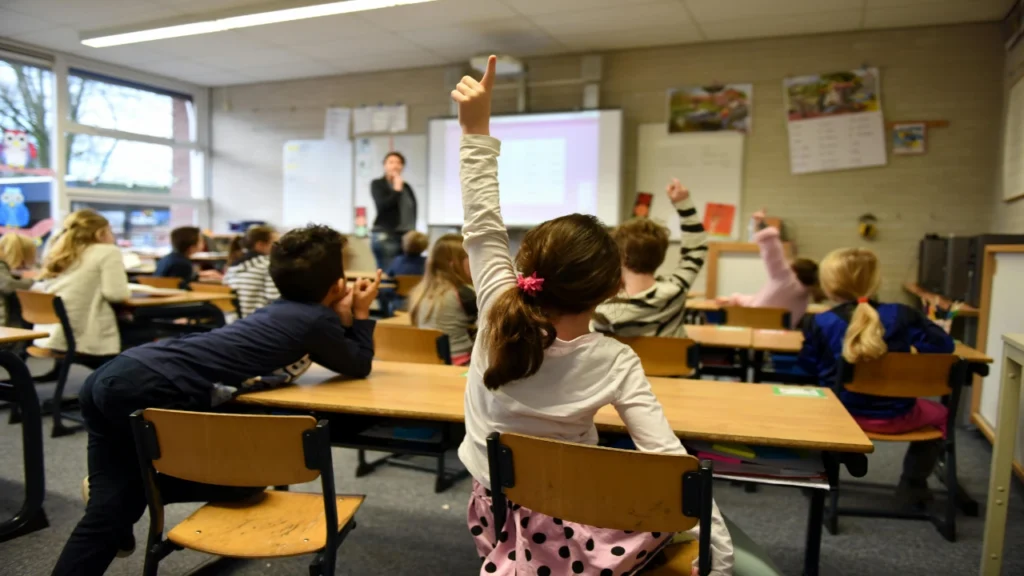
The most common concern about cold calling in the classroom is that it creates anxiety in students who are not confident or who do not know the answer. This concern is legitimate and worth addressing directly, because poorly implemented cold calling does create anxiety. Well-implemented cold calling reduces it over time.
The anxiety associated with cold calling comes from two sources: the fear of being wrong in front of peers, and the feeling of being singled out by the teacher. Random selection addresses the second concern completely. The first requires deliberate classroom culture work alongside the technique.
Compare two teachers using the same random name picker. The first responds to a wrong answer with “No, that’s wrong. Anyone else?” The class tenses. Students start hoping the wheel does not land on them. The second responds to the same wrong answer with “Interesting thinking. Can anyone build on that?” The class stays engaged. The difference is not the tool. It is the culture around the tool.
Effective implementation starts with how the teacher responds to incorrect or incomplete answers. If wrong answers are met with redirection rather than correction, and if partial answers are built upon rather than dismissed, students learn that being called on is not a test they can fail in a meaningful sense.
Starting with lower-stakes questions in the first two to three weeks of using random selection allows students to experience the process as non-threatening before it is applied to more challenging material. By the time the questions become harder, the culture of random participation is already established and the wheel has become a normal part of how the classroom operates.
Practical Setup for Daily Use
The tool needs to be ready before the lesson starts. Setting up your random selection tool mid-class while students wait signals that the process is an afterthought rather than a deliberate system.
Add all student names to your random selection tool at the start of the term. For teachers with multiple class periods, maintain a separate list for each class. Tools such as Wheelofnames.com or Pickerwheel.com are free, require no account, and save lists in the browser between sessions. You can also use the random number generator by assigning each student a number and selecting randomly, which is faster to set up at the start of a new class without entering every name.
Display the wheel on a projector or classroom screen. Visibility is not optional. It is what makes the selection feel fair rather than arbitrary. Students watching the wheel spin see exactly what the teacher sees. There is no moment where a student can reasonably claim they were targeted, because the selection process is visible to everyone simultaneously.
The correct sequence for every question
- Ask the question clearly and completely.
- Give at least three seconds of silent wait time. Do not fill the silence.
- Spin the wheel to select a student.
- Allow the selected student to respond.
- Respond to the answer in the same way regardless of whether it is correct.
Spin after asking the question, not before. Spinning first and then asking the question removes the wait time benefit, because the selected student knows they will answer before they have processed the question.
Handling edge cases consistently
Decide in advance what happens when an absent student is selected and communicate this rule to the class before the first spin. The simplest approach is to spin again immediately. Whatever the rule, apply it identically every time. Inconsistency in edge cases is what creates the perception of favoritism in an otherwise fair system, because students notice when the rules change depending on who was selected.
The Effect on Classroom Dynamics Over Time
The most significant change that cold calling in the classroom with random selection produces is not immediate. It develops over several weeks of consistent application.
Students who previously disengaged because they knew they would not be called on begin preparing more consistently. The participation gap between confident and less confident students narrows. Students who rarely volunteered answers in a hand-raising model often discover through random selection that they know more than they thought, which builds confidence over time rather than undermining it.
A student who is randomly selected and gives a correct answer in front of the class experiences something that volunteering does not produce: the knowledge that they can perform under conditions they did not control. That experience is more confidence-building than a volunteered answer, because it removes the possibility that the student only answered because they were certain they were right.
Teachers who use random selection consistently also report that it changes their own behavior. Because they are no longer managing the social dynamics of who to call on, they have more cognitive bandwidth to focus on the quality of their questions and the substance of student responses rather than on participation logistics.
Common Mistakes That Undermine Cold Calling in the Classroom
Spinning too quickly after asking the question. Skipping wait time defeats one of the main benefits of the technique. The three-second pause is what ensures all students are actively processing, not just the one who will be selected. Without it, cold calling produces stress rather than thinking.
Using random selection only for difficult questions. If students associate the spinning wheel exclusively with hard questions, the anticipation becomes anxiety rather than engagement. Use it for easy and hard questions alike so that being selected does not signal the difficulty of what is coming.
Treating incorrect answers differently from correct ones in front of the class. Public correction of wrong answers teaches students that being called on carries real risk. Redirect, build on, or thank the student and open to others, but never signal that being wrong publicly is something to avoid. This is the single most important cultural practice that determines whether cold calling produces engagement or fear.
Stopping the practice when a student seems uncomfortable. Occasional discomfort is part of the learning process. Stopping random selection in response to visible discomfort from one student sends the message to the entire class that discomfort can override the system. Address anxiety individually and privately. Maintain the practice publicly.
Not displaying the tool on a shared screen. A random selection tool that only the teacher can see produces the same trust problem as teacher-directed selection. The visibility of the process is what makes the outcome accepted.
Cold Calling vs. Other Participation Methods: A Comparison
| Method | Equity | Student accountability | Anxiety level | Evidence base |
|---|---|---|---|---|
| Hand-raising (volunteer only) | Low, favors confident students | Low, opt-out is easy | Low for volunteers | Documented concentration in small group |
| Round-robin (fixed order) | Medium, predictable coverage | Medium, students know their turn | Medium, predictable | Limited; predictability reduces alertness |
| Teacher-directed cold calling | Variable, subject to unconscious bias | High | High, feels targeted | Good and Brophy: bias well documented |
| Random cold calling with visible tool | High, equal probability | High, anyone can be called | Medium, decreasing with consistency | Lemov, Rowe, Tobin: strongly supported |
Grade-Level Considerations for Cold Calling in the Classroom
Primary school (K-5). The visual and auditory experience of a spinning wheel is itself engaging for younger students and tends to reduce anxiety because it feels more like a game than a selection process. Keep questions short and factual in the early stages. Build toward more open-ended questions as the practice becomes established.
Middle school (6-8). This is the age group where hand-raising produces the most severe participation inequity, because social dynamics are at their peak intensity and the cost of being wrong in front of peers feels highest. Random selection is particularly valuable here because it removes the social targeting dimension entirely. The wheel selected them, not the teacher.
High school (9-12). Older students respond well when the rationale is explained directly before the practice begins. A brief explanation of why random selection is fairer than volunteering, delivered once at the start of the year, tends to produce acceptance rather than resistance. Pair random selection with higher-order questions that do not have a single correct answer to reduce the performance anxiety of being wrong.
Adapting Cold Calling in the Classroom for Remote and Hybrid Settings
Cold calling in the classroom with random selection translates directly to remote and hybrid settings with one adjustment: the tool must be visible to all participants simultaneously.
For fully remote classes, share the browser tab showing the wheel during a video call so all students see the spin happen in real time. The shared visual experience maintains the same accountability dynamic as in-person random selection.
For hybrid classes where some students are present and some are remote, display the wheel on the classroom screen and ensure it is visible in the camera frame so remote students see it at the same time as in-person students. Both groups experience the selection simultaneously, which maintains the fairness perception for all participants.
For guidance on how to use spinner and selection tools specifically in remote settings, our article on how to use a spinner wheel effectively for teachers and streamers covers the technical setup in detail.
Frequently Asked Questions
Does cold calling in the classroom work for all age groups?
Yes, though implementation varies by age. With younger students, the visual experience of the spinning wheel reduces anxiety because it feels participatory rather than threatening. With older students, consistent application and a non-punitive classroom culture matter more than the specific tool used.
What if a student genuinely does not know the answer?
Treat it as normal, because it is. “I am not sure” is a valid response. Follow it with a prompt such as “What do you know about this topic?” or open the question to another student before returning to the first student with a simpler follow-up. The goal is that every interaction with the system ends with the student having contributed something, even if it is small.
How is random cold calling different from just calling on any student?
The visible randomness is the key difference. A teacher calling on students without a visible system introduces unconscious patterns that students detect over time, even when they cannot articulate what those patterns are. The spinning wheel makes the selection visibly impartial, which changes how students perceive both the process and the teacher’s intentions.
Can I use a random selection tool for remote or hybrid classes?
Yes. Share the browser tab showing the wheel during a video call so remote students see the same spin as in-person students. The shared visual experience maintains the accountability dynamic regardless of physical location.
How long does it take for cold calling to change classroom culture?
Most teachers who implement it consistently report noticeable changes in engagement within two to three weeks. Full cultural change, where being called on feels genuinely normal rather than stressful, typically takes four to six weeks of consistent application. The timeline depends heavily on how incorrect answers are handled in the first few weeks.
Conclusion
Cold calling in the classroom works because it makes participation non-optional for every student in every lesson. Random selection makes cold calling fair, visible, and consistent in a way that teacher judgment alone cannot replicate.
The combination works because each element addresses a different problem. The cold call removes the opt-out that hand-raising allows. The wait time ensures every student has processed the question before anyone is selected. The visible randomness removes the social targeting that makes teacher-directed selection feel punitive. The consistent culture around incorrect answers removes the risk that makes students fear being called on.
None of these elements work in isolation. Together, they produce a classroom where participation is expected, equitable, and over time, genuinely normal.
For a complete guide to building the participation systems that support this kind of classroom culture, see our article on equal chance random selection and how it works in practice.
References
Good, T. L., & Brophy, J. E. (2003). Looking in classrooms (9th ed.). Allyn & Bacon.
Lemov, D. (2021). Teach like a champion 3.0. Jossey-Bass.
Rowe, M. B. (1974). Wait-time and rewards as instructional variables, their influence on language, logic, and fate control. Journal of Research in Science Teaching, 11(2), 81-94. https://doi.org/10.1002/tea.3660110202
Sadker, M., & Sadker, D. (1994). Failing at fairness: How America’s schools cheat girls. Touchstone.
Tobin, K. (1987). The role of wait time in higher cognitive level learning. Review of Educational Research, 57(1), 69-95. https://doi.org/10.3102/00346543057001069